

MLKN.lab — Multi-Layered Knowledge Network Ideas Laboratory
MLKN.lab
A computational metascience platform mapping the structural topology of human knowledge through a polyhierarchical, data-driven framework.
Overview
A Polyhierarchical Framework for Computational Epistemology
MLKN.lab is a computational metascience initiative dedicated to mapping, modeling, and quantifying the epistemic topology of global scientific discovery. By treating knowledge as a dynamic, multi-layered hypergraph, we reveal hidden structures, bridges, and gaps across disciplines— enabling researchers to navigate, analyze, and predict the evolution of science itself.
Built from bibliometric analysis of large-scale scholarly metadata (OpenAlex, Scopus, MeSH, IEEE Thesaurus), MLKN.lab operationalizes a polyhierarchical framework across:
- 5 Ontological Layers (Core Domains → Concepts).
- 6 Epistemological Core Domains (Formal Sciences, Natural Sciences, etc.).
- 25 Academic Disciplines (e.g., Computer Science, Neuroscience).
- 235 Subdisciplines (e.g., AI, Cognitive Psychology).
- 320K+ Interdisciplinary Connections.
MLKN.lab is multifaceted, operating as:
Research Platform
A living laboratory for testing hypotheses about the evolution of science.
Scientific Instrument
A high-precision tool for graph-theoretic analysis of knowledge networks.
Cognitive Interface
A generative system to augment human reasoning through interactive knowledge maps.
Built for Research, Meta-Science, and Education.
Scientific Impact
Why MLKN.lab Matters for Research, Education, and Policy
MLKN.lab is more than a tool—it’s a paradigm shift in how we understand and interact with knowledge. Our framework enables groundbreaking applications across disciplines:
For Researchers
Uncover hidden connections between disciplines, identify emerging fields, and test metascience hypotheses.
Example: How does interdisciplinarity impact citation networks?
For Educators
Design interdisciplinary curricula and adaptive learning paths using MLKN.lab’s knowledge maps.
Example: Bridging Computer Science and Cognitive Psychology.
For Policymakers
Inform science policy by visualizing gaps, silos, and opportunities in research.
Example: Identifying underfunded interdisciplinary areas.
For AI Developers
Enhance AI reasoning with structured knowledge networks from MLKN.hypergraph.
Example: Grounding LLMs in scientific knowledge.
Featured Insights
Discover the Hidden Patterns of Scientific Knowledge
★ Featured — Knowledge Diffusion
How Ideas Spread Across Disciplines
Our analysis of 320K+ connections reveals how concepts like "Transformers" diffuse from AI to neuroscience, linguistics, and beyond.
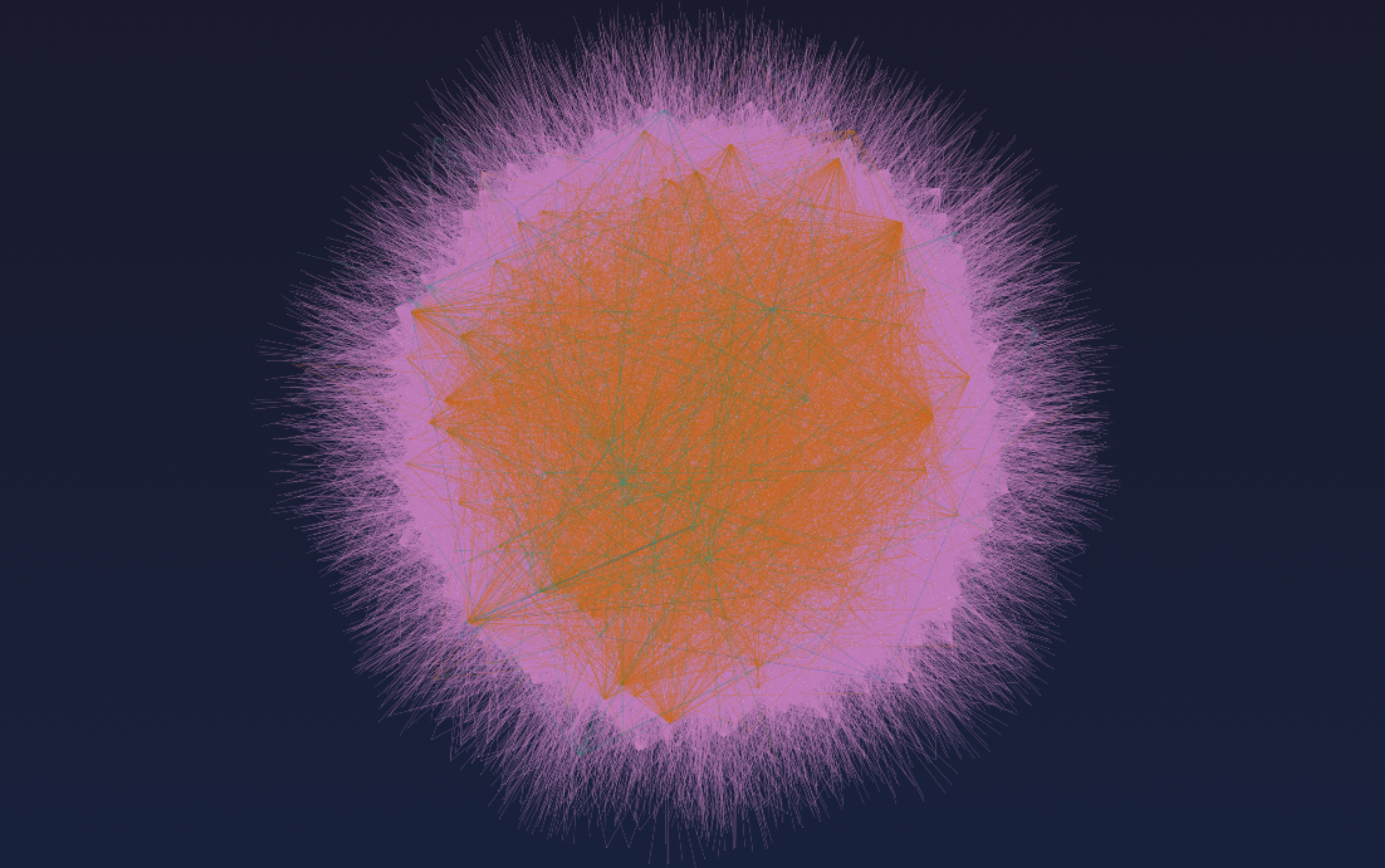
Figure 1: Static preview of the Interactive visualization MLKN.hypergraph mapping knowledge topology across 25 disciplines and 5 ontological layers.
Research Focus
A Polyhierarchical Framework for Computational, Cognitive, and Interdisciplinary Research
Discover the research focus. These include the research foundations, research methods, research nexuses, and research applications.
Research Foundations
The theoretical and philosophical underpinnings of MLKN-lab.
Research Methods
The analytical and computational approaches driving MLKN-lab.
Research Nexuses
Convergent Hotspots of Innovation and Exploration.
Research Applications
Practical implementations of MLKN-lab across domains.
MLKN.model
The Computational Epistemology Engine
MLKN.model is the mathematical and computational heart of MLKN.lab. It treats scientific knowledge as a dynamic, multi-layered hypergraph \( \mathcal{H} \), enabling rigorous analysis, simulation, and prediction of how disciplines evolve, connect, and diffuse.
Just as physics engines simulate the behavior of physical systems, MLKN.model simulates the behavior of knowledge systems— revealing hidden patterns, testing hypotheses, and enabling breakthroughs in metascience, AI, and interdisciplinary research.
Theoretical Foundations
Built on unified theories of cognition, network science, systems theory, and computational epistemology. Models knowledge as a computational system where structure can be analyzed and optimized.
Mathematical Formalization
Formalizes knowledge as a multilayer hypergraph \( \mathcal{H} = (V, \mathcal{S}, \mathcal{P}, \mathcal{T}, \omega, \tau) \), with 5 ontological layers (Core Domains → Concepts) and hyperedges for cross-disciplinary connections.
Architecture
Organized into 3 core layers: Knowledge Representation (polyhierarchy), Network Analysis (graph theory, TDA), Dynamic Simulation (random walks, GNNs).
MLKN.model - Mathematical Foundations
The Rigor Behind MLKN.model
The mathematical backbone of MLKN.model is a multilayer hypergraph \( \mathcal{H} = (V, \mathcal{S}, \mathcal{P}, \mathcal{T}, \omega, \tau) \), where knowledge is formalized as a dynamic, multi-layered network. This framework enables rigorous analysis, simulation, and prediction of scientific structures.
Formal Definition
A multilayer hypergraph where:
- \( V \): Nodes (Core Domains → Concepts).
- \( \mathcal{S} \): Hyperedges (cross-disciplinary connections).
- \( \mathcal{P} \): 5 ontological layers.
- \( \mathcal{T} \): Hierarchical edges (adjacent layers).
- \( \omega \): Weights (e.g., citations, semantic similarity).
- \( \tau \): Temporal function (evolution over time).
Key Properties
The framework is:
- Multilayer: 5 ontological layers (Core Domains → Concepts).
- Polyhierarchical: Nodes can have multiple parents.
- Dynamic: Tracks evolution via \( \tau \) and \( \mathbf{T}_{\mathcal{H}} \).
Mathematical Tools
Supports:
- Graph theory (adjacency, Laplacian matrices).
- Topological Data Analysis (persistent homology).
- Optimal Transport (Wasserstein distance).
Method
How MLKN.lab was built: Data, Classification, and Validation
All the methods are available below. These include the data source, classification logic, network construction and validation.
Data Sources
We use OpenAlex as our primary data source, supplemented by Scopus, MeSH, and IEEE Thesaurus for thematic and conceptual mappings.
Classification Logic
Disciplines and subdisciplines are classified using OECD Frascati Manual and UNESCO Fields of Science, ensuring alignment with global standards.
Network Construction
We map connections between disciplines using co-occurrence analysis and citation networks to reveal interdisciplinary links.
Validation
Our hierarchy is validated through network metrics (e.g., centrality, modularity) and expert review to ensure accuracy.
Polyhierarchy
A polyhierarchical framework of 6 Core Domains, 25 Disciplines, and 235 Subdisciplines
Explore the description of the hierarchy. These include the ontological layers, epistemological core domains, the academic disciplines, the subdisciplines, the topics, and the concepts.
Ontological Layers
5 Ontological Layers
Core Discipline Domains
Layer 1 embraces 6 Core Domains: Engineering & Technology, Formal Sciences, Natural Sciences, Health & Medical Sciences, Social Sciences & Humanities.
Academic Disciplines
Layer 2 comprises 25 Academic Disciplines as distinct clusters, organized into their respective Core Domains.
Academic Subdisciplines
Layer 3 represents 235 specialized subfields within each discipline (e.g., AI within Computer Science).
Core Thematic Domains
Layer 4 contains thematic clusters within subdisciplines (e.g., Machine Learning within AI).
Main Thematics
Layer 5 includes fundamental thematics and concepts (e.g., Supervised Learning within Machine Learning).
MLKN.hypergraph
Interdisciplinary Knowledge Networks
Explore the mutliple knowledge networks. These present the interdisciplinary knowledge network and 25 disciplinary knowledge networks.
Interdisciplinary Knowledge Network
Explore the interdisciplinary knowledge network
Core Discipline Domains
6 high-level scientific domains organizing the 25 disciplines.
Disciplinary Knowledge Networks
Explore the 25 individual discipline networks
Academic Disciplines
25 disciplines organized into the 6 Core Domains.
Data
Access the datasets and reports powering MLKN.lab
All our reports and datasets are available below. These include the full hierarchy, network edges, and validation reports.
Scientific References
Theoretical and Methodological Underpinnings
MLKN.lab is grounded in a rich tradition of metascience, network theory, computational epistemology, and cognitive science. Below are 10 key references that inspire our work. For the full bibliography, visit our Scientific References page.
Open Access Monographs
Theoretical and Methodological Underpinnings
MLKN.lab is grounded in a rich tradition of metascience, computational epistemology, cognitive architectures, and network theory. Below are 10 key open-access monographs that inspire our work. For the full collection, visit our Open Access Monographs page.
Applications
Scientific analytical tools and future applications for MLKN.lab
All our reports and datasets are available below. These include the full hierarchy, network edges, and validation reports.
Essays
Scientific and Meta-Essays on Interdisciplinarity
Explore the intersections of knowledge, interdisciplinarity, and the future of science. These include the meta-essays and applied essays.
Meta-Essays
Theoretical explorations of knowledge, interdisciplinarity, and the future of science.
Applied Essays
Practical applications of MLKN.lab in AI, education, policy, and more.
About
Multi-Layered Knowledge Network Ideas Laboratory
François Papin
Researcher and creator of MLKN.lab. Background in cognitive psychology and education, with a passion for interdisciplinary knowledge mapping.
Mission
To bridge the gaps between scientific disciplines through a unified, hierarchical framework that reveals hidden connections and fosters collaboration.
Vision
A world where knowledge is seamlessly interconnected, enabling researchers, educators, and policymakers to address complex challenges collaboratively.
The Three Dimensions of MLKN-lab
A Research Platform, Scientific Instrument, and Cognitive Interface
MLKN-lab is multifaceted, because it is simultaneously a research platform , a scientific instrument , and a cognitive interface .
In others words, like AI, MLKN-lab is simultaneously a subject of study, a technology for research, and a new way to think, learn, and act in the world of knowledge.
Research Platform
MLKN-lab is a living laboratory for testing hypotheses about the nature of science. Just as AI is both a subject of study and a tool for studying other phenomena, MLKN-lab allows researchers to:
- Study the evolution of disciplines over time.
- Identify fragmentation and convergence in scientific fields.
- Explore the structural patterns of knowledge networks.
- Investigate the emergence of interdisciplinarity.
This dimension positions MLKN-lab as a testbed for metascience, where researchers can ask and answer fundamental questions about how knowledge is organized and evolves.
Scientific Instrument
As a scientific instrument, MLKN-lab provides a rigorous framework for analyzing the structure and dynamics of knowledge. Like a microscope or telescope, it reveals patterns that are invisible to the naked eye:
- Graph Topology: The geometric and topological properties of knowledge networks.
- Centrality: Identifying the most influential disciplines and concepts.
- Disciplinary Bridges: Mapping the connections between fields.
- Emergent Clusters: Detecting new and growing research areas.
- Conceptual Diffusion: Tracking how ideas spread across disciplines.
- Epistemic Isolation: Identifying silos and gaps in knowledge.
- Historical Shifts: Analyzing how disciplines evolve over time.
This dimension makes MLKN-lab a powerful tool for bibliometrics, network science, and systems analysis.
Cognitive Interface
Finally, MLKN-lab serves as a cognitive interface—a way for humans to interact with and make sense of knowledge systems that have grown too complex for traditional academic structures. It enables users to:
- Navigate: Explore large-scale knowledge networks intuitively.
- Discover: Uncover hidden connections and patterns.
- Visualize: See the structure of knowledge in interactive maps.
- Learn: Understand complex fields through layered, interconnected representations.
This dimension transforms MLKN-lab into a tool for education, decision-making, and innovation, much like how AI augments human cognition.
Get in Touch
Connect with us to collaborate or learn more about MLKN.lab.